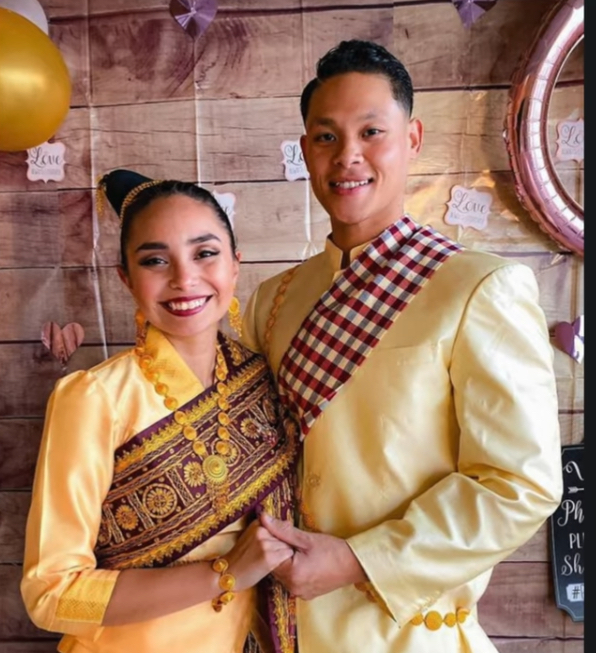

Dylan Chathapathet grew up in America hearing his parents speak Thai and Lao. They were Buddhists, but he had so many questions.Throughout high school he made fun of religion, especially Christians. In the military, alcohol and negative friends pulled him down.
Here the rest of Dylan's story in his own words:
I was raised in a Buddhist home with two loving parents and a younger brother. From a very early age, I began to question matters of faith. Why do we bow before this statue? Who is Buddha? Who is God? These questions stayed with me as I grew older, constantly circling my mind.
Eventually, I enlisted in the military. During that time, I identified as an atheist, which later shifted to agnosticism. I reasoned with myself, “Maybe there is a God. If so, at least I might have a place in heaven.” God was laying his plans to reach me.
After completing my military service, I met a special lady named Cindy, in December of 2016. Our conversations were deep and stimulating, often centering on faith and current events. When the topic of faith arose, I defaulted to science as my foundation. Rather than pushing Cindy away, my skepticism invited patience and kindness from her. She thoughtfully addressed my questions and rebuttals, explaining that science and faith are not opposed. She shared that Seventh-day Adventists fully embrace scientific understanding—something even reflected in the Bible.
In May of 2017, while driving home from work, I experienced a supernatural encounter with the Holy Spirit. Physically, I felt at peace. Mentally, I felt free. Spiritually, I knew—without any doubt—that God loved me. In that very moment, it was as if someone had flipped on a light switch. I knew God was real. Soon after, I accepted the gift of salvation and was baptized.
However, while we live in this world, a life with God does not guarantee a life without challenges. I struggled deeply, attempting to please others by keeping my faith hidden. The more I concealed my faith, the more difficult life became—both internally and externally. Outwardly, I hid my Bible to avoid suspicion. I sang songs of praise only late at night, prayed quietly so no one would hear me speaking to God, and attended church in secret, telling my family I was visiting friends on Saturday mornings.
Inwardly, I wrestled with painful thoughts: Can I be a Christian and still perform Buddhist rituals? What will my family think? What if they disown me? I knew my heart could not be divided. I was terrified of fully letting go of Buddhism because I feared losing my family. It broke my heart knowing I loved Jesus with all my being, yet lacked the courage to let go completely.
I became angry with God. My prayers took on a different tone: “God, why me? Why did You choose me? This is too hard. I don’t want to go through this. Why couldn’t You choose someone else?”
Still, God remained patient and unrelenting.
Several months later, a close family member passed away, and fear filled my heart. I knew what would be expected of me. In Buddhism, when a relative dies, men and young men participate in a ritual called buat na fai. This ritual is intended to earn merit, or good karma, on behalf of the deceased to help their soul attain a better rebirth or Nirvana. The ritual involves shaving one’s head, ceremonial bathing, donning orange robes, and reciting prayers such as Namo Tassa—a phrase of reverence directed toward the Buddha.
As the funeral approached, I began preparing to move out of my parents’ home. I packed my belongings, loaded my truck, and reached out to friends in search of a place to stay. When I arrived at the funeral, my heart pounded as I felt the shocked stares of relatives who noticed I was not participating in buat na fai. I locked eyes with my parents and saw the look of disappointment on my mother’s face. My heart sank. When the ceremony began, I was expected—as the eldest son—to initiate the ritual by bowing before the statue of Buddha and placing incense sticks into a bowl. Relatives urged me to stand, but I refused.
In that moment, I knew my heart belonged fully to Jesus. I had the strength to stand firm because the Holy Spirit gave it to me at that exact moment. After the funeral, I could no longer hide my faith. I openly admitted to my family that I was a Christian. At first, my mother resisted, often mocking my faith. Yet the Lord reminded me to turn the other cheek and continue loving.
Over time, my family—though still Buddhist—became more understanding and accepting. My mother eventually told me they noticed a change in me: I had become more gentle, wise, loving, bold, and compassionate. For all of this, I give credit to Jesus. I hope and pray that one day I will worship side by side with my family. Until then, I continue to live for Christ as a sinner saved by grace.
To those who are struggling with conflicting faiths, know that you are understood. I understand the fear and the pain. But I urge you not to let fear determine your eternity. Losing family is frightening, but where you choose to stand for eternity matters far more. My friend, there is no love greater than the love of Jesus. What He has done for you, no one else can do. God bless you!
Dylan Chathapathet
Now Dylan helps in a Home for All Nations gathering that serves Laotian, Cambodian, and other immigrants. He says, “I feel so privileged because I get to translate the gospel. In the future I’d like to start a clinic in Laos. I want to share the gospel with them since they do not even know who Jesus is and what God has done for them!”
Hear Dylan's story in his own words.


